Picture a Friday night service: every burner firing, the dishwasher cycling non-stop, floor drains handling the constant runoff from prep stations. Then, somewhere around 7 PM, the kitchen floor starts to rise. Not dramatically at first, just a slow, foul-smelling pool of wastewater creeping out from the floor drain nearest the fryers. Within twenty minutes, your entire dinner service has ground to a halt. Your revenue stops too.
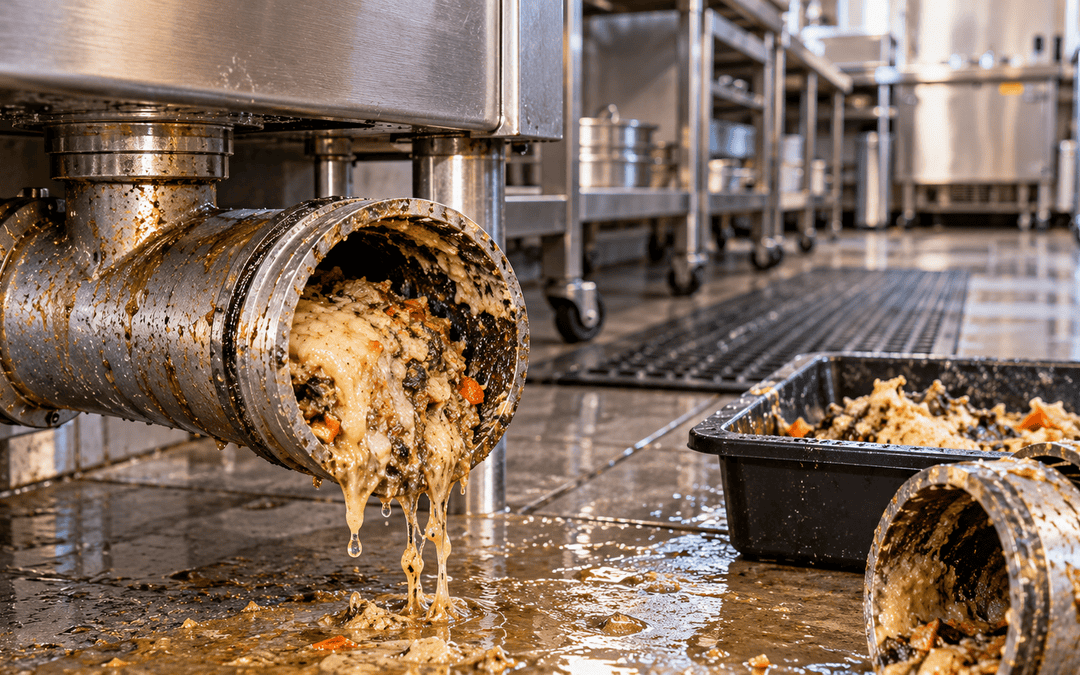
That scenario is the end result of a commercial drain backup for grease: the chemical and physical transformation of fats, oils, and grease (FOG) as they cool inside the pipe network. Hot grease poured down a drain does not stay liquid. It travels a short distance, loses heat to the surrounding pipe walls and soil, and turns into a sticky, wax-like solid that coats the interior of lateral lines. Over days and weeks, that coating thickens as food particles embed into it, narrowing the flow path until the pipe closes entirely during your busiest shift.

The Physics of FOG: How Warm Liquids Turn into Solid Blockages
When fats, oils, and grease (FOG) leave a commercial sink at cooking temperature, they behave like any other liquid, flowing freely and following gravity. The problem begins a few feet down the line, where the pipe temperature drops sharply. Grease does not need to reach freezing temperatures to solidify; most animal fats and cooking oils transition from liquid to semi-solid well within the temperature range of underground plumbing. The solidification process is gradual, not sudden, which is part of why it is so easy to underestimate. Each wash cycle deposits a fresh layer, and that layer cools and hardens before the next one arrives.
The hot water trick, running hot water down the drain while washing greasy pans, is one of the most common myths in commercial kitchen management. Hot water does move grease further down the line, but it does not make it disappear. By the time that grease reaches the lateral lines connecting the building to the municipal sewer, the water has cooled enough that the grease drops out of suspension and adheres to the pipe wall. The blockage forms further from the kitchen, which makes it harder to detect and considerably harder to reach with standard equipment.
Once grease solidifies on a pipe wall, the surface becomes rough and tacky, acting like a sticky binder that catches every piece of organic material passing through the drain. Fine food particles, soap residue, and mineral deposits all get pulled into this layer, adding mass and density with each passing service. This is the compounding blockage pattern that plumbers encounter in commercial kitchens that have gone without maintenance: what started as a thin grease film has become a dense, irregular mass that has reduced a 4-inch pipe to an effective diameter of an inch or less.
Standard mechanical snakes can punch through this kind of obstruction, but they rarely clear it. It is a temporary fix. The cable creates a temporary channel through the grease, and within a day or two, sometimes hours, the blockage reforms as the disturbed material settles back. Professional drain cleaning using hydro-jetting equipment is the only method that strips the grease layer from the pipe wall rather than just displacing it, restoring the pipe’s full flow capacity so your kitchen can keep running.
The Food Waste Factor: How Organic Debris Fuels the Clog
Grease alone can cause a backup, but food waste is what speeds up the process dramatically. Think of solidified grease as a matrix and food particles as the aggregate: together, they form something closer to concrete than a soft blockage. The structural aggregate role that food waste plays is what makes commercial kitchen clogs so much denser and more resistant than residential ones. Starches are particularly destructive: pasta, rice, and bread absorb water and swell, then combine with surrounding grease to form a thick, adhesive paste that resists flushing even under high water pressure. Fibrous materials like celery, corn husks, and onion skins do not dissolve at all. They weave into the grease layer and create a physical mesh that snags everything passing through afterward.
Many kitchen managers assume that running food waste through a commercial disposal unit eliminates the drain risk, but that is a major misconception. It does the opposite. Grinding food into smaller particles makes it easier for those particles to travel past the sink trap, but it also makes them far easier for the grease downstream to capture. Finely ground starch and protein particles embed into grease layers more thoroughly than larger chunks would. The disposal moves the problem further into the pipe, where it is harder to address and more expensive to clear.
- Starchy foods (pasta, rice, bread): Expand in water and combine with grease to form a thick, glue-like paste that resists flushing.
- Fibrous organic waste (celery, corn husks, vegetable peels): Create a dense, fibrous web inside the pipe that acts as a physical filter, catching other solids.
- Animal fats and dairy products: Solidify rapidly at room temperature, forming the structural foundation of the blockage.
- Coffee grounds and eggshells: Do not dissolve; instead, they settle into the sticky grease layers, adding weight and density to the obstruction.
Training kitchen staff on daily FOG prevention is one of the most cost-effective investments a commercial operator can make. Our plumbing maintenance tips cover practical, staff-ready guidance on proper waste disposal, grease handling, and daily drain care, which are the kind of operational habits that reduce the load on your drainage system before a plumber ever needs to get involved.
The Anatomy of a Commercial Kitchen Drainage System
Wastewater leaving a commercial sink travels through local branch lines, which are smaller-diameter pipes that connect individual fixtures to the main drain network. From there, it passes through a grease interceptor (if one is installed and functioning), then enters the main lateral lines that carry everything out to the municipal sewer. That path sounds simple, but it is full of high-risk zones: every horizontal run, every elbow fitting, and every low-slope section of pipe is a place where FOG can slow down, cool, and begin to accumulate. Horizontal pipe runs with insufficient slope are especially vulnerable because wastewater moves through them more slowly, giving grease more time to separate from the water column and adhere to the pipe wall.
The grease interceptor does meaningful work, but it is not a complete solution. Grease still gets through. Under-sink grease traps capture a significant portion of FOG from individual fixtures, and larger gravity interceptors handle higher volumes from the full kitchen. Emulsified grease, which is grease broken into fine droplets by detergents or high-pressure spray, can pass through an interceptor without being captured. If the interceptor itself is overloaded or has not been cleaned on schedule, its efficiency drops sharply. The grease that escapes goes directly into the lateral lines, where it behaves exactly as described above.
Because no interceptor is perfectly efficient, a consistent plumbing maintenance routine is the only reliable way to keep exposed lateral lines clear over the long term. Even a well-designed system with a properly sized interceptor will accumulate grease in the lateral lines under the daily volume of a busy commercial kitchen. Scheduled inspections and cleaning cycles catch that accumulation before it reaches a critical threshold.
In Northeast Florida specifically, the high water table and shifting sandy soils create additional stress on commercial drain lines. Pipes can shift slightly over time, altering the slope of horizontal runs and creating low spots where grease and solids pool. This is a less-discussed but genuinely significant factor for commercial operators in the Orange Park, Jacksonville, and Green Cove Springs areas, and it is one reason why routine camera inspections are worth scheduling alongside regular cleaning.
- Under-sink grease traps: Designed to capture grease from individual fixtures but require frequent, manual cleaning to maintain efficiency.
- Gravity grease interceptors: Large underground tanks that handle high volumes from the full kitchen but must be pumped out on a strict schedule to prevent overflow and bypass.
- Cleanout access points: Critical entry locations that allow plumbers to inspect and clear lateral lines without dismantling kitchen infrastructure.
- Sewer lateral lines: The final pathway connecting the commercial facility to the municipal sewer main, and the most common site of deep, severe grease blockages.
Signs Your Commercial Drains Are Heading for a Backup
The early warning signs of an approaching backup are easy to rationalize away during a busy service, which is exactly why so many commercial kitchens end up in emergency territory. A drain that takes a few extra seconds to clear isn’t just acting up; it is telling you that the flow path has narrowed and the obstruction is growing. The odor indicator is equally diagnostic: a sulfur-like smell rising from floor drains means that organic food waste is decomposing inside a layer of trapped grease somewhere in the pipe. That smell doesn’t come from a clean drain. It is a warning. When that odor appears alongside slow drainage, the blockage is already well-established.
The most urgent signal is the multi-fixture slowdown: when two or more sinks, floor drains, or dishwasher connections are all draining slowly at the same time. A single slow fixture usually points to a localized blockage near that fixture. When multiple fixtures across the kitchen are affected simultaneously, the obstruction is in the main lateral line, downstream of where all those branch lines converge. At that point, a complete backup is not just a possibility; it is a matter of timing, and the timing is rarely convenient.
If your kitchen is showing any of these signs, the window for a simple cleaning is narrowing. Our team provides diagnostic inspections and commercial drain services across the region, so you should reach out to schedule an assessment through our plumbing services in St. Johns County page, or contact us directly to discuss your kitchen’s specific drainage situation. The earlier a professional can assess the blockage, the more options are available for clearing it cleanly.
Preventative Strategies: Keeping Your Kitchen Flowing
- Implement a strict scraping policy: Ensure all plates, pots, and pans are thoroughly scraped into trash cans before they reach the dishwashing station, as this single habit removes the majority of solid food waste before it ever contacts the drain.
- Use drain strainers in every sink: Fine-mesh strainers in prep, three-compartment, and handwashing sinks catch the solid particles that grease would otherwise trap downstream.
- Keep a grease disposal log: Collect all bulk cooking oils in designated recycling containers and maintain a dated disposal record; this creates accountability and helps identify when grease volumes are increasing.
- Schedule professional hydro-jetting: High-pressure water jetting on a preventative cycle, not just in response to a backup, keeps pipe walls clean and eliminates the slow accumulation that leads to emergencies.
Hydro-jetting is the gold standard for commercial drain maintenance, and the reason comes down to what it does to the pipe wall. A mechanical snake creates a channel through a blockage, but it leaves the grease coating intact. The grease stays behind. Hydro-jetting uses high-pressure water to scour the interior walls of the pipe, stripping the grease layer entirely and restoring the pipe’s original diameter. Professional plumbers calibrate the equipment to match the pipe material: cast iron and PVC have different pressure tolerances, so the process clears the obstruction without damaging the line. The result is not just a cleared drain; it is a pipe that is genuinely clean and significantly less hospitable to the next round of FOG accumulation. Treating this as preventative maintenance rather than emergency response reduces your costs: a scheduled jetting service costs a fraction of what an after-hours emergency call and a kitchen shutdown will run during a peak service period.
Daily best practices are your first line of defense, but managing commercial plumbing also means staying current on the regulatory landscape. Municipal FOG management programs, as referenced in EPA municipal wastewater guidelines, increasingly require commercial kitchens to maintain documentation of grease trap cleaning and disposal practices. And as national plumbing code standards continue to evolve, per Contractor Magazine’s plumbing code roundup, staying ahead of compliance requirements is part of responsible kitchen management, not just good plumbing hygiene.
Frequently Asked Questions About Commercial Drain Backups
What should I put in the drain to dissolve grease?
Enzymatic cleaners and biological agents can help break down organic matter gradually, and they are a reasonable supplement to a regular maintenance schedule. Chemical drain cleaners are a different matter: they are corrosive to pipe materials, they do not effectively penetrate heavy grease deposits, and they create hazardous conditions for any plumber who needs to work on the line afterward. For a commercial kitchen dealing with heavy grease buildup, professional mechanical cleaning and regular grease trap maintenance are the reliable long-term solution, not off-the-shelf chemistry.
How long does it take for grease to build up in pipes?
The timeline depends on the volume of FOG entering the drain and the water temperature, but in high-volume commercial kitchens without active grease management, significant blockages can develop in a matter of weeks. A kitchen running multiple fryers and a high-throughput dishwasher is depositing grease into the drain system with every single service. Without routine inspections, that accumulation compounds quietly until it becomes a visible problem, usually at the worst possible time.
Can you put hardened grease down the drain?
No, you should never put hardened grease down the drain. It is too risky. Hardened grease should be scraped into a sealed container and disposed of in the trash. Putting it down the drain creates an immediate, localized blockage right at the point of entry, and it coats the pipe wall in a way that accelerates future accumulation. There is no scenario where this is a reasonable disposal method for a commercial kitchen.
What size grease trap do I need for a commercial kitchen?
Grease trap sizing is calculated based on the flow rate of your kitchen equipment, specifically the capacity of your sinks and the volume of water used during peak operating hours. Local plumbing codes govern the minimum size requirements, and those codes vary by municipality. A licensed plumber can run the flow rate calculations and confirm that your installation meets current local standards, which matters both for compliance and for ensuring the interceptor functions as designed under real kitchen conditions.
What should I do during an immediate commercial drainage emergency?
Shut off water usage to the affected fixtures immediately to prevent the backup from spreading further across the kitchen floor. Avoid chemical drain openers: they can create hazardous fumes and residue that complicate the work for the responding technician. Contact an emergency plumber in Orange Park or your local service area as quickly as possible. The faster a professional can assess the blockage, the better the chance of clearing it before it causes structural damage or triggers a health code violation.
Contact Us Today
Managing FOG and food waste is a daily routine for every commercial kitchen in Northeast Florida. Understanding the physical mechanics, like how grease solidifies, how food particles embed into it, and how the accumulation compounds over weeks and months, is what separates operators who respond to crises from those who prevent them. The drainage system under a commercial kitchen is not self-cleaning, and the consequences of neglecting it are measured in lost revenue, health code violations, and emergency service calls during peak hours. Neglect costs money. When you are ready to establish a maintenance schedule that keeps your system ahead of the problem, our team provides reliable plumbing services in Jacksonville and throughout the surrounding communities, including Orange Park, Middleburg, Green Cove Springs, and Fleming Island.
Contact Lance Maxwell Plumbing at (904) 209-9103 to schedule a commercial drain inspection and discuss a hydro-jetting maintenance plan tailored to your kitchen’s volume and equipment. Our master plumbers serve commercial operators across Orange Park, Jacksonville, Middleburg, and Green Cove Springs, and we are available for both scheduled maintenance and emergency response.