In almost every jurisdiction across the country, backflow preventers must be tested at least once a year, which is the direct answer to how often you need to schedule this service. Annual testing is not a suggestion buried in a utility pamphlet: it is a codified requirement tied to your active water service, and skipping it carries real consequences that range from fines to a shutoff notice at your meter.
If you’re reading this because a letter from JEA or the Clay County Utility Authority just landed in your mailbox, you’re not alone. That compliance notice tends to arrive without much context, and the anxiety it creates is understandable. You’re suddenly wondering whether your water is safe, whether you’re already in violation, and what this whole process actually costs. Those are fair questions, and they deserve straight answers. We have them.
At Lance Maxwell Plumbing, we’ve been serving homeowners and commercial property managers in Orange Park, Jacksonville, Middleburg, and throughout Clay and Duval Counties since the early 1990s. Our team is available 24/7 on-call, which means a compliance deadline or an unexpected plumbing issue doesn’t have to wait until Monday morning. We want to help you understand the exact testing frequencies required by law, why the mechanical components inside your device wear out faster than most people expect, and what a licensed master plumber does during a professional test.
Understanding Backflow and the Silent Guardian in Your Plumbing
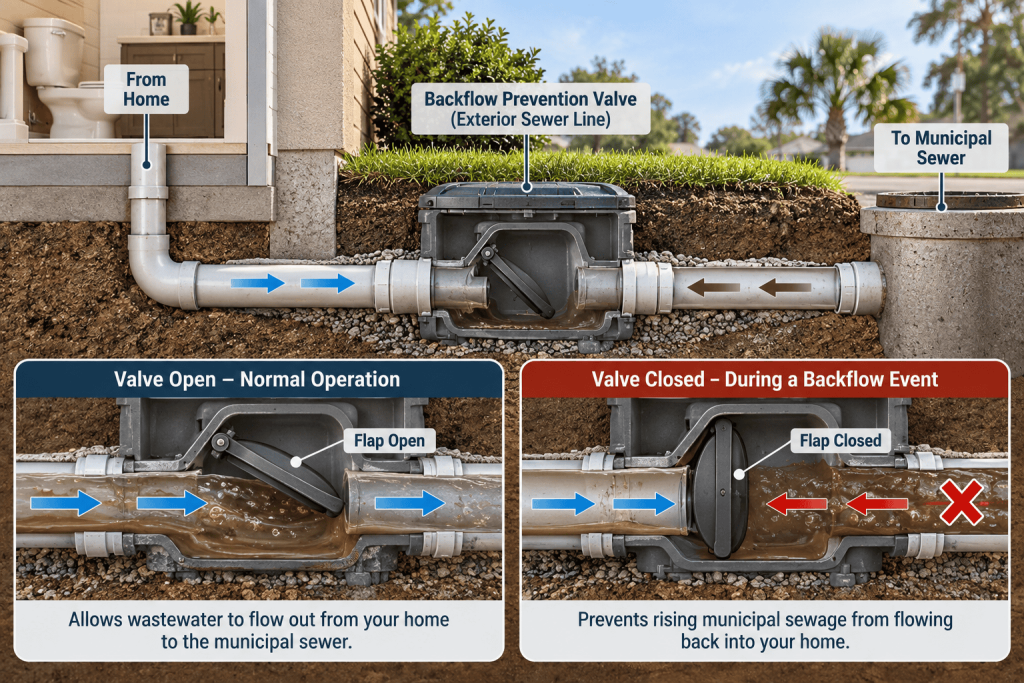
Your water supply is designed to move in one direction: from the municipal distribution system into your home. Think of it as a one-way street: clean, treated water flows toward you, and nothing flows back. A cross-connection is any actual or potential link between that drinking water supply and a nonpotable water source, such as an irrigation line sitting in a lawn chemical solution or a fire sprinkler system filled with treated antifreeze (per the EPA Cross-Connection Control Fact Sheet). When that connection exists and city water pressure drops, whether during a main break, a heavy-demand event, or a firefighting operation nearby, the pressure differential reverses. Water from your private plumbing gets siphoned backward into the public distribution system. It happens in an instant. That reversal is backflow, and it happens faster and more silently than most homeowners ever expect (per the EPA Cross-Connection Control Fact Sheet).
The public health stakes are serious. Backflow events can push chemical or microbiological contamination directly into the drinking water supply that your neighbors, your block, and potentially your entire district share (per the EPA Cross-Connection Control Fact Sheet). To guard against this, water utilities establish cross-connection control programs that require property owners to install and maintain approved backflow prevention assemblies, which are mechanical devices that physically block reversed flow. These assemblies show up across a wide range of residential and commercial applications: private irrigation systems, fire sprinkler systems, solar water heating systems (per the EERE Solar Water Heating Guide), and shared drainage systems connected to condensate-producing HVAC equipment (per the ENERGY STAR Water Management Requirements). If your property has any of these systems, you almost certainly have a backflow prevention device installed somewhere, and it needs to be verified on a schedule.
How Often Is Backflow Testing Required?
The answer to how often for backflow testing is determined by your local municipality and state plumbing code, not by a single federal standard. That said, the overwhelming agreement across jurisdictions is an annual backflow inspection schedule: one certified test per calendar year, submitted to your water utility as proof of compliance. The variation you’ll encounter between municipalities tends to involve which specific assemblies are approved for which hazard levels, not whether annual testing is required. On that point, there’s very little disagreement.
It’s worth understanding how municipal oversight works. Public water systems conduct sanitary surveys to identify potential cross-connections, typically at least once every three years for community water systems and once every five years for non-community systems (per the EPA Cross-Connection Control Fact Sheet). Those surveys are the utility’s internal audit. Your annual test is a separate, property-level obligation that falls entirely on you as the property owner. While the city checks the broader grid, verifying your specific device falls on you, and both layers have to function for the local water system to hold.
The mechanical reason behind annual testing makes perfect sense when you look inside the device. Backflow preventers contain springs, rubber seals, and check valves that are under constant pressure. Over time, those components compress, crack, and lose their seating, kind of like how the soles on your favorite work boots slowly wear down and lose their grip. You can’t see this degradation from the outside, and the device gives no audible warning when a seal begins to fail. A certified test is the only way to confirm the internal components are still holding the pressure differentials they were designed to hold.
- Annual Testing Requirements: Most municipal water utilities, including JEA in Jacksonville and the Clay County Utility Authority, require a certified test report every 12 months to maintain uninterrupted water service.
- New Installation Testing: Any newly installed backflow prevention assembly must be tested immediately before the plumbing system is cleared for use. The device doesn’t get a grace period just because it’s brand new.
- Post-Repair Testing: Whenever a backflow assembly is repaired, relocated, or replaced, it requires an immediate follow-up test to verify the mechanical integrity of the new or serviced components.
- High-Hazard Applications: Commercial properties handling highly toxic chemicals or biological materials may face semi-annual testing requirements under local codes, depending on the hazard classification assigned to their cross-connections.
Keep your home safe and stay fully compliant with local municipal codes. Schedule your professional, certified backflow testing and certification with the team at Lance Maxwell Plumbing today.
The Real Risks of Skipping Your Annual Backflow Test
Backflow contamination is genuinely invisible. It carries no reliable odor, no discoloration, and no taste that would alert you to a problem. You cannot rely on your senses to know whether the water coming out of your kitchen tap has been compromised. The primary signs of a cross-connection and backflow incident are customer complaints about water odor, discoloration, or direct physical harm, meaning that by the time anyone notices, the contamination has already reached the tap (per the EPA Cross-Connection Control Fact Sheet). A 2010 study by the Water Research Foundation, using backflow-detecting water meters, found that 5% of homes register a backflow incident of 1 gallon or more each year (per the EPA Cross-Connection Control Fact Sheet). In a neighborhood of 200 homes, that rate means roughly 10 properties experience a measurable backflow event annually, and most of those happen without the homeowner ever knowing.
The documented consequences of unprotected cross-connections are not hypothetical. They are real and dangerous. In the western United States, a customer connected a surface water irrigation line to a public water system serving 2,500 people without installing an approved backflow prevention assembly. When pressure in the irrigation line increased, untreated water flowed back into the county system, water samples tested positive for E. coli, and a “Do Not Use” notice went out to the entire service area (per the EPA Cross-Connection Control Fact Sheet). In the southeastern United States, a backflow event in a system serving 500,000 people forced aqueous fire-fighting foam into the homes of approximately 40,000 customers, a contamination event that was ultimately resolved only by installing a backflow prevention assembly (per the EPA Cross-Connection Control Fact Sheet). Even with professional oversight in place, the common thread in both cases was a single unprotected cross-connection.
- Health Hazards: Pathogens like E. coli, heavy metals, pesticides, and fertilizers can enter your drinking water supply without any warning, creating acute health risks for everyone in the household.
- Municipal Fines: Failing to submit a certified test report by your utility’s deadline can result in financial penalties from JEA or the Clay County Utility Authority, with fees that accumulate the longer the violation persists.
- Water Service Interruption: Utilities hold the legal authority to shut off water service to any property that fails to comply with testing mandates, a disruption that affects your entire household or commercial operation until compliance is restored.
- Property Damage and Liability: If a backflow event originating on your property contaminates the public distribution grid, you may face significant legal and financial exposure, particularly if downstream harm to other customers can be traced back to your cross-connection.
Factors That Affect Your Backflow Preventer’s Lifespan
The heavy brass housing on most backflow prevention assemblies is built to last. Under normal conditions, that outer body can hold up for several decades without structural failure. The internal components are a different matter entirely. They wear out quickly. The rubber seals, springs, and check valves inside the assembly are under continuous pressure, and they degrade on a much shorter timeline, typically requiring service or outright replacement every 5 to 10 years, depending on water quality, usage patterns, and environmental exposure. The brass body might look fine from the outside while the seals inside have already lost their ability to hold a proper seat.
In Northeast Florida, a handful of regional factors speed up that internal wear faster than the national average might suggest. High ambient humidity creates persistent moisture around outdoor assemblies, which promotes corrosion on metal components and degrades rubber seals more quickly than in drier climates. Sandy soil conditions throughout Clay and Duval Counties allow ground movement and shifting that can stress the fittings and connections around an outdoor assembly over time. Seasonal rainfall patterns in the region are heavy and concentrated, meaning outdoor irrigation system backflow preventers cycle through significant temperature and pressure swings during the wet season. All of that adds up to wear that arrives ahead of schedule.
Irrigation system assemblies deserve particular attention. They’re installed outdoors, often at grade level or just above it, which exposes them to direct sunlight, temperature fluctuations, and incidental contact with lawn chemicals. An irrigation backflow preventer that looks structurally intact on the outside can have a cracked diaphragm or a fouled check valve that only a pressure differential test will catch.
Don’t wait for a compliance letter or a water quality issue to arise. Contact Lance Maxwell Plumbing today to have your backflow preventer inspected and tested by a certified local professional.
What Happens During a Professional Backflow Test?
A certified backflow test follows a defined sequence that most homeowners can plan around without any significant hassle.
- Water Shutoff: The technician briefly shuts off the water supply to your property, typically for 10 to 30 minutes, to perform the test safely and accurately.
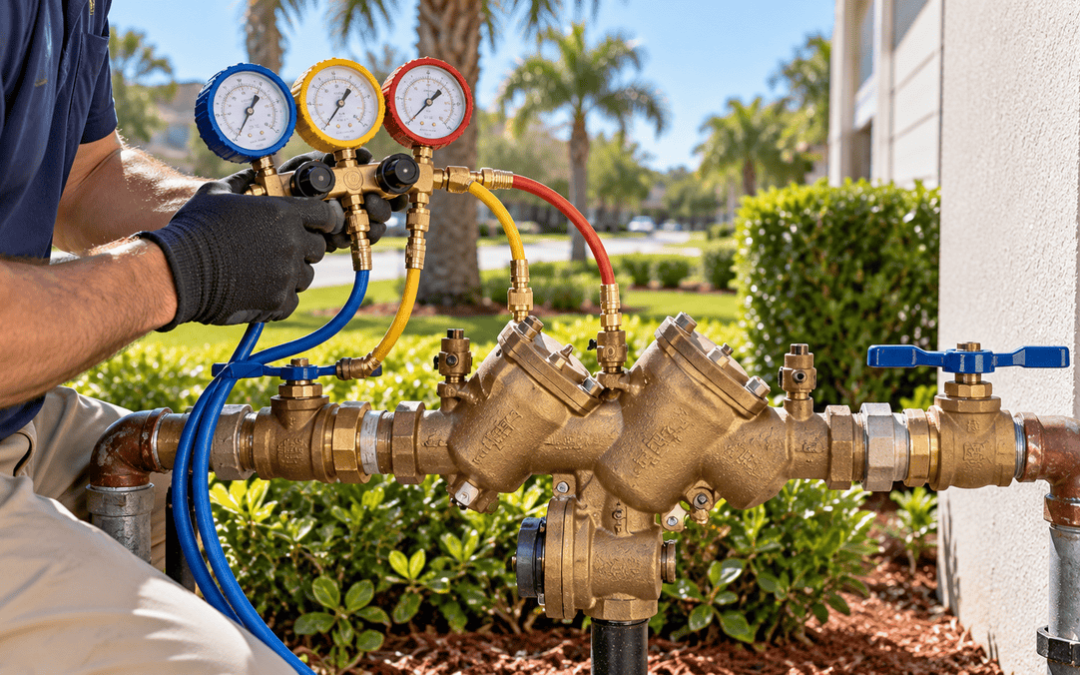
- Gauge Connection: A specialized, calibrated test kit is connected directly to the test cocks on the backflow assembly. This equipment measures pressure with a precision that standard plumbing gauges can’t match.
- Pressure Differential Testing: The technician measures the pressure differentials across the internal check valves and relief valve to confirm they hold tight against reversed flow under the required thresholds. This is the core of the test; everything else is setup and documentation.
- Reporting and Submission: When the device passes, the technician completes the official test report and submits it directly to your local water utility, which is JEA or the Clay County Utility Authority, on your behalf. You don’t have to navigate the submission portal or track down the right form.
- Repair Recommendations: If the device fails, the technician identifies the specific worn components, such as a degraded rubber seal, a fatigued spring, or a check valve that won’t seat properly, and recommends the targeted repairs needed to restore compliance before your deadline.
Choosing a locally certified plumbing service matters more than most property owners realize when it comes to backflow compliance. Local expertise is key. The regulations governing allowable assemblies, testing frequency, and submission requirements are set at the state and municipal level, not by a single national standard (per the EPA Cross-Connection Control Fact Sheet). A plumber in Orange Park, FL, who works in Clay and Duval Counties every day knows the exact submission portals, the specific forms JEA and the Clay County Utility Authority require, and the local code nuances that can trip up an out-of-area contractor. Our team handles the entire process, from the initial pressure test through any necessary repairs or component replacements, so you’re not left managing paperwork or chasing down compliance confirmations on your own.
Frequently Asked Questions About Backflow Testing
How long does it take to do backflow testing?
A professional backflow test generally takes between 30 and 60 minutes from start to finish. The actual time depends on how accessible the device is and whether your plumbing configuration requires any additional steps to isolate the assembly. When the device is easy to reach and passes on the first attempt, most technicians have your water back on well within that window. If the device is buried under landscaping or located in a tight mechanical room, expect the upper end of that range.
Is backflow plumbing or HVAC?
Backflow prevention falls under the scope of plumbing. Backflow prevention devices are integrated directly into your drinking water supply lines, and their purpose is to protect drinking water from contamination, which is a plumbing function by definition. The confusion with HVAC arises because some mechanical systems, particularly those with condensate-producing components, connect to shared drainage systems that require their own backflow prevention measures. In those cases, the backflow device itself is still a plumbing component, even if it’s installed in proximity to HVAC equipment.
How long will a backflow preventer last?
The brass outer body of a backflow preventer is genuinely durable: it can hold up for several decades under normal conditions. The internal components are where the lifespan conversation gets more complicated. Springs, rubber seals, and check valves are under constant pressure and wear down through normal use, typically reaching the point of needing service or replacement somewhere between 5 and 10 years. Annual testing catches this degradation before it becomes a compliance failure or a contamination event, which is exactly why the testing schedule exists.
How much should it cost to replace a backflow valve?
Replacement costs vary considerably based on the size of the device, its location, and the type of assembly your system requires. As a general market range, property owners typically pay anywhere from $300 to $1,500 or more, with that figure covering professional labor, quality parts, and the permits the work requires. Devices installed in difficult-to-access locations, or larger assemblies serving commercial fire suppression systems, tend to sit at the higher end of that range. Getting a written estimate before work begins is always the right move.
Do you need a permit to replace a backflow device?
In most municipalities throughout Clay and Duval Counties, yes. Replacing a backflow prevention device is classified as a significant plumbing modification, which means it requires a local plumbing permit and a follow-up inspection to confirm the new installation meets current health, safety, and cross-connection control standards. Skipping the permit process doesn’t just create a code violation; it can also leave you without documented proof of compliance if your utility requests installation records down the line.
Contact Us Today
Protecting your home’s drinking water and keeping your plumbing compliant doesn’t have to be a stressful ordeal. We make it easy. At Lance Maxwell Plumbing, we’ve been handling backflow testing, certification, and repairs for homeowners and commercial property managers in Orange Park and Jacksonville since the early 1990s. We know what JEA requires, we know what the Clay County Utility Authority expects, and we know how to get your paperwork submitted correctly the first time. Whether you received a routine compliance notice, you’re overdue for your annual test, or you’re dealing with an aging irrigation assembly that’s been out in the Florida sun for a decade, our 24/7 on-call team is ready to help with transparent service and no hidden fees.
Ready to schedule your annual backflow test or have questions about a compliance letter? Don’t wait; contact Lance Maxwell Plumbing today to speak with our certified team and secure your home’s clean water supply.