A hidden plumbing leak can be frustrating because the problem is often easy to notice but difficult to locate. You might hear water running when every faucet is turned off, notice a damp spot on the floor, or receive a water bill that suddenly looks more like a car payment. In situations like these, professional leak detection services help locate the source of escaping water without immediately opening walls, floors, or ceilings. If you are wondering how does leak detection work, the short answer is that plumbers use specialized tools to look, listen, and measure for signs of water in places where a leak cannot be seen with the naked eye.
Leak detection is not one single test. Instead, it is a diagnostic process that combines plumbing knowledge with equipment such as electronic listening devices, thermal imaging cameras, and moisture meters. Each tool gives the plumber a different piece of information. When those clues are considered together, they can help narrow down the location of a leak and determine what repairs may be necessary.
For homeowners, that means less guesswork, a better chance of pinpointing the problem before repairs begin, and potentially less unnecessary damage to the surrounding area.
What Is Professional Leak Detection?
Professional leak detection is the process of finding the source of an unwanted water leak in a plumbing system. It is especially useful when there is evidence of a leak but no obvious dripping pipe or visible break.
Some leaks are easy to find. If water is spraying from the supply line beneath your bathroom sink, there is not much detective work involved. Other leaks may occur behind drywall, beneath flooring, inside ceilings, around fixtures, or underground.
A plumber may recommend leak detection when you notice signs such as:
- An unexplained increase in your water bill
- The sound of running or dripping water when fixtures are off
- Damp or discolored drywall
- Water stains on ceilings
- Musty odors
- Warped flooring or baseboards
- Warm or cool spots on flooring
- Mold or mildew growth around plumbing areas
- Reduced water pressure
- Water pooling in unusual locations
- A water meter that continues moving when no water is being used
Not every one of these symptoms automatically means you have a plumbing leak. Condensation, roof leaks, appliance problems, and other sources of moisture can sometimes create similar signs. That is one reason professional diagnosis matters.
Why Finding the Exact Location of a Leak Matters
When a plumber knows that water is escaping somewhere inside a wall, simply cutting open a large section of drywall and hoping to find the pipe is not the most efficient approach.
Modern leak detection equipment can help narrow the search.
The goal is to identify where the strongest evidence of leaking water appears before invasive work begins. While there are situations in which a wall, floor, or other surface must eventually be opened to repair the plumbing, finding the likely source first can minimize unnecessary demolition.
Accurate leak detection may also help homeowners address problems sooner. Even a relatively small leak can waste water and expose building materials to ongoing moisture. Over time, that moisture can damage drywall, flooring, cabinetry, insulation, and other materials.
Finding the problem early is generally much easier than waiting until the ceiling decides to provide its own indoor rain shower.
How Electronic Listening Devices Find Plumbing Leaks
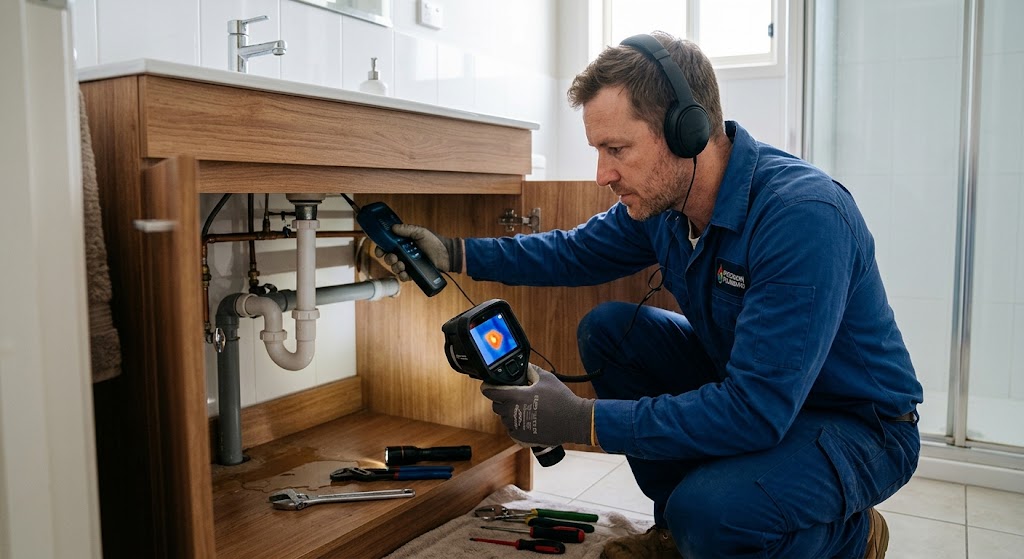
One of the most useful tools for detecting hidden leaks is an electronic listening device.
Water escaping from a pressurized plumbing pipe creates sound and vibration. Depending on the pipe material, water pressure, size of the leak, and surrounding materials, those sounds may travel through the pipe or nearby surfaces.
Electronic leak detection equipment is designed to amplify those sounds.
A plumber can place specialized sensors or listening equipment against different surfaces and compare what is heard in multiple locations. As the plumber gets closer to the leak, the sound may become stronger or more distinct.
Electronic listening equipment can be useful for investigating leaks in areas such as:
- Walls
- Floors
- Ceilings
- Water service lines
- Pipes running beneath concrete
- Other concealed plumbing locations
Using the equipment properly requires experience because houses are not quiet environments. HVAC equipment, appliances, traffic, pumps, flowing drains, and even normal plumbing operation can produce sounds that could be mistaken for a leak.
The equipment provides information, but the plumber still has to interpret that information correctly.
How Thermal Imaging Helps Detect Hidden Water
Thermal imaging sounds highly technical, but the basic idea is fairly simple.
A thermal imaging camera detects differences in surface temperature. It does not literally see through walls, and it does not produce an X-ray image of the plumbing system.
Instead, it shows temperature patterns.
When leaking water changes the temperature of drywall, flooring, ceilings, or another surface, a thermal camera may reveal an unusually warm or cool area. That temperature difference can give the plumber another clue about where water may be traveling.
For example, a hot water pipe leaking behind a wall may create a warmer area on the wall surface. A cold-water leak can sometimes create a cooler pattern, especially when moisture affects the surrounding materials.
Thermal imaging can be particularly useful because water does not always appear directly beneath the leak. Moisture can travel along framing, pipes, flooring, or other building materials before becoming visible.
The first water stain you see may therefore be several feet away from the actual plumbing problem.
A thermal camera can help the plumber examine the broader moisture pattern and determine where additional testing should be performed.
What a Moisture Meter Does
A moisture meter provides another valuable piece of the leak detection puzzle.
This handheld device measures moisture levels in or around building materials. Depending on the type of meter being used, the plumber may test drywall, wood, flooring, ceilings, and other surfaces.
Imagine that you notice a faint discoloration near the bottom of a wall. The surface may not feel wet when you touch it, but that does not necessarily mean the area is dry.
A moisture meter can help determine whether elevated moisture is present.
The plumber can then compare readings from different areas. If one section of a wall produces significantly higher readings than surrounding areas, it may indicate that moisture is accumulating near that location.
Moisture meters are particularly useful for answering questions such as:
- Is this area actually damp?
- How far has the moisture spread?
- Is moisture concentrated in one location?
- Are nearby materials showing normal moisture levels?
- Does the moisture pattern support the possibility of a plumbing leak?
A moisture meter generally cannot tell a plumber exactly which fitting or pipe has failed. Instead, it provides supporting evidence that can be combined with visual inspection, electronic listening, thermal imaging, and plumbing knowledge.
Why Plumbers May Use Several Leak Detection Methods
One of the most important things homeowners should understand about leak detection is that no single tool provides every answer.
A thermal camera may reveal an unusual temperature pattern, but that pattern could require confirmation with a moisture meter. A moisture meter may confirm that a wall is wet, but electronic listening equipment may help narrow down the location of the leaking pipe.
That is why experienced plumbers often use multiple methods.
Think of professional leak detection as putting together a puzzle. Each tool provides another piece.
A plumber may:
- Inspect the visible plumbing and surrounding area.
- Ask when the symptoms began.
- Examine water usage or meter activity.
- Listen for unusual plumbing sounds.
- Scan suspicious areas using thermal imaging.
- Take moisture readings.
- Compare findings from different locations.
- Narrow down the most likely source.
- Recommend the appropriate repair.
The exact process will depend on the property and the suspected problem.
What Should You Expect During a Leak Detection Service Call?
If you have never scheduled professional leak detection before, you may be wondering whether the plumber will immediately start cutting holes in your walls.
Typically, investigation comes first.
Here is what homeowners can generally expect.
The Plumber Will Ask About the Problem
The service call often begins with a conversation.
Your plumber may ask what you have noticed, when the problem started, and whether it seems to be getting worse.
Useful information might include:
- When you first noticed moisture
- Whether your water bill increased
- Whether you hear water running
- Whether the problem appears after using a certain fixture
- Whether the moisture is constant or intermittent
- Whether recent plumbing work has been performed
Do not worry if you cannot answer everything. You are not expected to diagnose the leak yourself. That is why the plumber is there.
Visible Plumbing Will Be Inspected
Before reaching for specialized equipment, the plumber may examine accessible plumbing fixtures and connections.
Sometimes what seems like a hidden leak turns out to be something relatively accessible, such as a leaking shutoff valve, toilet connection, faucet supply line, water heater fitting, or appliance connection.
Checking the obvious possibilities first can save time.
The Plumbing System May Be Tested
Depending on the suspected problem, the plumber may perform tests to determine whether water is escaping from the plumbing system.
The water meter may be checked while fixtures are turned off. Certain plumbing sections may also be evaluated individually.
The specific procedure depends on the type of plumbing system and the suspected leak location.
Leak Detection Equipment May Be Used
If the leak remains hidden, the plumber may begin using diagnostic equipment.
Electronic listening devices can help identify sounds associated with escaping water. Thermal imaging may reveal unusual temperature patterns. Moisture meters can help determine where building materials contain elevated moisture levels.
Rather than relying on one reading, the plumber may test several locations and compare the results.
The Likely Leak Location Will Be Narrowed Down
Once the evidence points toward a particular area, the plumber can explain what has been found and recommend the next step.
Sometimes additional access is required before the pipe can be repaired. The important difference is that the plumber is opening a targeted area based on diagnostic evidence rather than guessing.
Does Leak Detection Require Cutting Into Walls?
Not necessarily.
A major purpose of professional leak detection is to gather information before opening walls, floors, or ceilings.
Electronic listening, thermal imaging, moisture measurements, visual inspection, and plumbing tests may help identify the likely source without immediately disturbing finished surfaces.
However, leak detection should not be confused with leak repair.
If a damaged pipe is located behind drywall, the plumber will eventually need some form of access to repair it. Leak detection can simply help make that access more targeted.
The amount of access required depends on factors such as the location of the leak, pipe material, type of failure, and construction of the home.
Can Homeowners Find Leaks Themselves?
There are some useful checks homeowners can perform.
For example, you can turn off faucets and water-using appliances and watch your water meter. If the meter continues registering use when everything is off, that may indicate water is escaping somewhere.
You can also inspect beneath sinks, around toilets, near the water heater, around appliances, and anywhere you have noticed stains or dampness.
However, hidden leaks are more complicated.
A wet spot on the floor does not necessarily identify the point where a pipe is leaking. Water can travel before becoming visible. Without the proper equipment and plumbing experience, homeowners can easily end up investigating the wrong area.
If you suspect a hidden leak, professional leak detection can provide a much clearer picture of what is happening.
Why Fast Leak Detection Is Important
Waiting to investigate a suspected leak can allow a manageable plumbing problem to become a much larger household headache.
Continued water exposure may contribute to:
- Damaged drywall
- Swollen or warped wood
- Damaged cabinetry
- Flooring problems
- Stains on walls or ceilings
- Higher water consumption
- Mold and mildew conditions
- Damage to belongings
- More complicated repairs
Some leaks also worsen over time.
A small crack, weakened fitting, or deteriorating connection may begin by releasing a limited amount of water and eventually fail more severely.
If something about your plumbing does not look, sound, or smell right, having it checked sooner is usually a better strategy than waiting for undeniable proof.
Water has a rather inconvenient habit of providing that proof at the least convenient moment possible.
Frequently Asked Questions About Leak Detection
What is leak detection?
Leak detection is the process of locating water escaping from a plumbing system, particularly when the source is concealed behind walls, beneath floors, above ceilings, or in other difficult-to-access locations.
How does leak detection work?
Professional leak detection uses plumbing inspection and diagnostic tools to identify signs of escaping water. Plumbers may use electronic listening equipment, thermal imaging cameras, moisture meters, water meter tests, and other methods to narrow down the source.
Can a plumber detect a leak without opening the wall?
In many cases, a plumber can narrow down the likely location of a leak before opening a wall. However, access may still be necessary to confirm the problem and complete the repair.
Can thermal imaging see pipes through walls?
No. Thermal imaging does not see through walls. It detects differences in surface temperature that may indicate moisture, hot water, cold water, or other unusual conditions behind or near a surface.
What does a moisture meter tell a plumber?
A moisture meter helps determine whether a material contains elevated moisture. Comparing readings across an area can help identify where moisture is concentrated and how far it may have spread.
How do electronic leak detectors work?
Electronic listening devices amplify sounds and vibrations associated with water escaping from pressurized plumbing. A plumber compares sounds at different locations to help narrow down the potential source.
What are common signs of a hidden water leak?
Common signs include unexplained increases in water bills, damp areas, stains, musty smells, sounds of running water, warped flooring, reduced water pressure, and meter movement when no fixtures are being used.
Should I turn off my water if I suspect a leak?
If there is active or significant water leakage that could damage the property, shutting off the appropriate water supply may help limit damage until a plumber arrives. If you are unsure where the shutoff is located or whether it should be used, contact a plumbing professional for guidance.
Is leak detection the same as leak repair?
No. Leak detection identifies or narrows down the source of the problem. Leak repair involves accessing the damaged plumbing and correcting the failure.
When should I call a plumber about a suspected leak?
Contact a plumber when you notice unexplained water use, moisture, stains, running-water sounds, loss of pressure, or other signs suggesting water may be escaping from the plumbing system. Prompt investigation can help reduce unnecessary water waste and property damage.
Call Lance Maxwell Plumbing for Professional Leak Detection and Plumbing Service
When you suspect a hidden plumbing leak, guessing is rarely the best strategy. Professional leak detection can help determine where water is escaping so the problem can be addressed as efficiently as possible.
For experienced plumbing assistance, turn to Lance Maxwell Plumbing, your trusted Jacksonville plumber. At Lance Maxwell Plumbing, we have more than 31 years of experience providing plumbing installation and repair services throughout the Jacksonville and Orange Park areas. Our team provides a full line of plumbing services, from new construction plumbing and water heater installation to preventive maintenance and everyday plumbing repairs.
Our friendly and knowledgeable staff is committed to doing whatever it takes to meet the needs of every customer. Plumbing problems also have an unfortunate tendency to ignore normal business hours, which is why our team offers on-call 24/7 availability. Day or night, you can count on Lance Maxwell Plumbing to help resolve your plumbing issues.
To complement our premium plumbing services, we also offer high-quality plumbing products from trusted brands such as Delta, Kohler, and Moen.
If you have noticed signs of a hidden leak or need professional plumbing service in Jacksonville or Orange Park, do not wait for a small problem to become a major repair. Contact us today, and one of our representatives will be glad to help you address your plumbing needs.