If you’ve lived in Orange Park for any length of time, whether you’re tucked into a neighborhood near Doctors Lake, settled in Bellair, or out toward Holly Point, you already know what the Northeast Florida climate does to a house. The humidity is unforgiving, our soil stays warm year-round, and older homes carry decades of plumbing decisions made by previous owners. When a pipe starts weeping behind a wall, or the water pressure at your kitchen faucet drops to a trickle, you might wonder. Is this normal? The question isn’t just how to fix it, but what to replace it with. You need the right fit.
Understanding the different types of pipes for plumbing is genuinely the most useful place to start. Not because the answer is complicated, but because picking the wrong material for a Clay County home can mean repeating the same repair in ten years, or even sooner.

The Plumbing Pipe Landscape: Understanding Your Home’s Lifelines
Every residential plumbing system runs on two separate networks. They do different jobs. The first is a pressurized water supply system that pushes clean water into your home. The second is a gravity-fed drain-waste-vent system that carries wastewater out. These two networks have different demands, and the materials that work well for one don’t always make sense for the other. Think of your drain system like a downspout on your roof, while your supply lines are more like a garden hose under constant, heavy pressure.
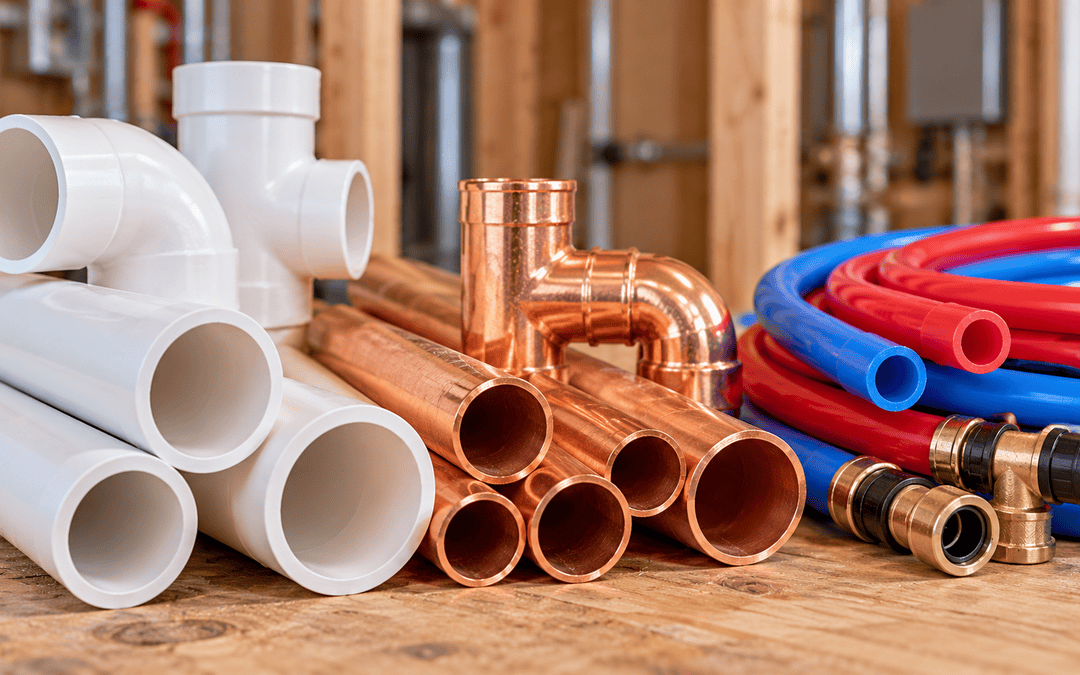
The three materials you’ll encounter in modern homes are PVC, copper, and PEX. Each has a purpose. Each has a specific role, a specific set of strengths, and a specific way of failing when conditions turn against it. For homes in Clay and Duval counties, where warm, moist soil speeds up certain kinds of corrosion and municipal water treatment chemistry puts its own stress on metal pipes, material selection matters more than it might in a drier climate.
Older homes transitioning away from galvanized steel or polybutylene pipes need to evaluate modern repiping materials carefully: not just for upfront cost, but for how each option holds up against the specific conditions behind your walls and beneath your slab.
Comparing PVC, Copper, and PEX: Pros, Cons, and Local Suitability
At a high level, these three materials differ in cost, flexibility, and where they’re permitted to be used. One distinction that trips up a lot of homeowners: standard PVC is a rigid material approved for cold water service lines and drainage, but it is not designed for pressurized hot water supply. PEX and copper handle both hot and cold supply lines. They are versatile. Mixing up those roles isn’t just a code issue: it’s a failure waiting to happen.
Here’s how each material breaks down for residential use:
- PVC (Polyvinyl Chloride): Primarily used for main water service lines entering the home and for drain-waste-vent systems. Per the Florida Building Code local amendments, water service pipes must have a minimum diameter of 3/4 inch to meet required pressures. Threaded PVC fittings must meet Schedule 40 requirements under ASTM D 2464, and gasketed systems require concrete thrust blocks formed against solid, hand-excavated trench walls. Trench backfill must be free of rocks larger than 1 inch in the first 6 inches above the pipe, and final backfill must be free of debris larger than 3 inches.
- Copper: Long considered the traditional standard for pressurized supply lines, copper is durable, UV-resistant, and naturally resistant to bacteria. The catch for Northeast Florida homeowners is that modern municipal water treatments can interact with copper over time, gradually wearing down the inner walls and producing tiny, hard-to-detect pinhole leaks. Add in the high cost of both the material and the skilled labor required to solder it correctly, and copper becomes a harder sell for whole-home installations.
- PEX (Cross-linked Polyethylene): A flexible, corrosion-resistant plastic tubing that has become the preferred choice for complete whole-house repiping services. PEX expands and contracts with temperature changes, making it highly resistant to the rare but real Florida freeze events. Fewer joints in the run means fewer potential leak points, and its flexibility significantly reduces installation labor compared to rigid materials.
Not sure what’s currently running behind your drywall? A failing pipe rarely announces itself until the damage is already done. Don’t wait. Reach out to a plumber in Orange Park, FL, for a thorough inspection before a slow leak becomes a flooring replacement.
Copper Piping: The Traditional Standard Facing Modern Challenges
Copper earned its reputation honestly. It has been the backbone of residential plumbing for generations, and a well-installed copper system in a home with favorable water chemistry can last for decades. The problem is that municipal water treatment has evolved, and the chloramines now commonly used as disinfectants interact with copper differently than older chlorine-based treatments did. Over time, that interaction can thin the pipe walls from the inside out, producing pinhole leaks that are nearly invisible until they’ve already soaked insulation or damaged a subfloor.
Many homes in Orange Park were built on concrete slab foundations, with copper water lines running directly beneath or through the concrete. This is common. When one of those lines fails, the repair requires jackhammering the floor: a process that’s expensive, intrusive, and leaves a home looking like a construction site for days. The alternative, during a full repipe, is to abandon the slab lines entirely and route new piping through the attic and down through interior walls, bypassing the concrete altogether to save your floors from damage.
If your older copper pipes are starting to show their age, you don’t have to keep patching the same system. Lance Maxwell Plumbing offers pressure-free whole-house repiping consultations, and a planned upgrade is almost always less expensive and far less stressful than an emergency repair at midnight.
PEX Piping: The Modern Solution for Northeast Florida Homes
The flexibility of PEX is what makes it so well-suited to the “up-and-over” repipe method that has become standard practice for slab homes in this area. Plumbers run the new supply lines through the attic and down into walls, completely sidestepping the concrete slab and eliminating any need to cut into floors. The result is a faster installation, less drywall disturbance, and significantly lower labor costs compared to a copper repipe of the same scope. It saves money.
PEX is fully certified for potable drinking water, resists corrosion, and doesn’t accumulate scale the way older metal pipes do. Both PEX and copper, when installed correctly by a licensed professional, are designed to last for decades under normal operating conditions. That said, PEX does have real drawbacks: it degrades when exposed to direct UV light, which means any outdoor or exposed runs need to be protected or replaced with a UV-resistant material. It also requires a metallic transition pipe before connecting to a water heater: you can’t run PEX directly into the heat source, because nobody likes a freezing cold shower. And in homes with known rodent activity, PEX in crawlspaces or unprotected areas is vulnerable to gnawing damage. Mice love chewing it.
As our team always says, choosing the right pipe isn’t just about the material: it’s about protecting your home and your family’s peace of mind.
Florida Building Code Standards for Residential Piping
What are the five types of plumbing pipes?
There are five primary pipe materials used in residential plumbing systems:
- PEX
- PVC
- copper
- ABS
- galvanized steel
Galvanized steel is the one you most want to find and replace: it corrodes from the inside as it ages, and that internal rust buildup is one of the most common causes of low water pressure in older homes. If your house was built before the mid-1980s and has never been repiped, there’s a reasonable chance galvanized steel is still somewhere in the system.
How do I tell if I have PEX or PVC?
PEX is flexible, meaning you can bend it by hand, and it’s typically color-coded: red for hot water lines, blue for cold, and sometimes white or clear for either. PVC is rigid, thick-walled, and usually white or cream-colored. In most homes, PVC handles drains and main service lines, while PEX (or copper in older homes) handles the indoor water supply. If you find flexible, color-coded tubing running through your walls or attic, that’s PEX.
Do new homes use PEX or copper?
Most modern homebuilders default to PEX because it installs faster, bends around framing without fittings, and costs considerably less than copper. Copper still shows up occasionally for main water service lines entering the home or for outdoor exposed connections where UV resistance is needed, but for interior supply runs, PEX has largely taken over new construction in this region.
What is the downside to PEX plumbing?
While PEX is highly versatile, it does carry a few specific drawbacks:
- UV exposure: PEX breaks down when sunlight hits it directly, so any exposed outdoor run needs protection.
- Rodent damage: In homes with pest problems, particularly in crawlspaces, rodents can chew through PEX tubing in ways they typically won’t with copper or PVC.
- Heat proximity: PEX cannot handle direct high heat at the connection point.
Because of this heat sensitivity, PEX cannot be connected directly to a water heater; a metallic transition section is required to handle the heat at the connection point.
Can you bury PEX directly in the ground?
Certain types of PEX pipe are rated for direct burial, provided they’re installed below the local frost line and shielded from sharp rocks or physical damage. Florida’s frost line is shallow compared to northern states, but local codes still govern how buried lines must be protected. Per the Florida Building Code local amendments, trenching standards require careful attention to backfill material: initial backfill within 6 inches of the pipe must be free of rocks larger than 1 inch, and final backfill must be clear of debris larger than 3 inches. When in doubt, a licensed plumber will know exactly what your local jurisdiction requires.
Contact Us Today
While PVC, copper, and PEX each have valid applications, modern PEX is generally the most efficient and cost-effective path for whole-home repiping in Orange Park, especially in slab-on-grade construction where attic routing eliminates the need to touch the floor. That doesn’t mean copper is obsolete or PVC has no place; it means the right answer depends on your home’s specific layout, your water chemistry, and what you’re trying to accomplish. A knowledgeable local plumber can sort through those variables with you in a single visit.
Lance Maxwell Plumbing has been keeping Northeast Florida homes safe and dry since 1994, earning “Best of Clay” recognition four consecutive years running. Here’s what some of your neighbors have said:
“Ryan and Tory were great! They both were very professional and respectful. Their work was done with great pride. Would recommend this company. So glad I chose them. Thanks guys for doing a great job.” – Arthur Schnapp
“The receptionist at the office was very helpful and friendly. Max Santiago came out to look at my well pump and was very professional and thorough with the service call. I have used them several different times and have been very happy with their service.” – Melody Wise
Whether you’re dealing with a stubborn leak, planning a renovation, or finally ready to replace aging pipes throughout your home, reach out to a trusted local plumber who knows Orange Park, Jacksonville, Middleburg, Green Cove Springs, Fleming Island, Clay County, and Duval County inside and out. Give us a ring; our team is available 24/7 at (904) 209-9103, and we’ll handle the rest.